
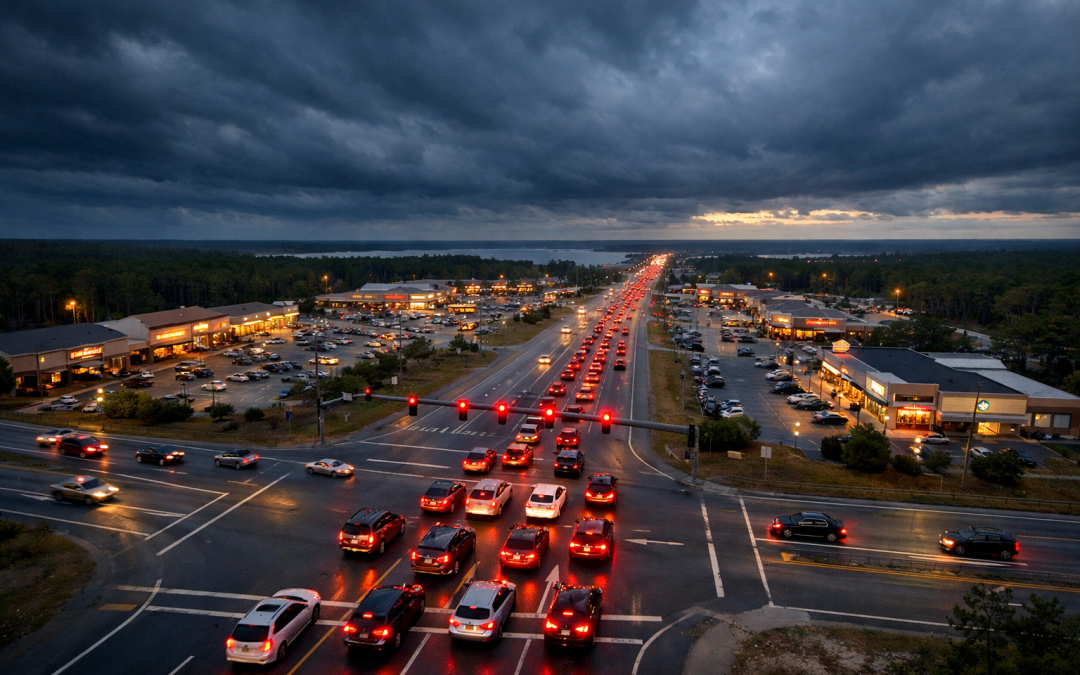
Brunswick County roads are getting more dangerous every year.
The county grew by 24% between 2020 and 2024, according to the North Carolina Office of State Budget and Management. That means roughly 33,000 new residents, more cars on roads that were never built for this volume, and intersections that keep racking up crashes. I drive these roads. I know where the problems are. And if you have been hurt at one of these intersections, I know how to help you get compensated.
Which Intersection Is the Worst?
The intersection of US 17 and NC 211 is the highest-crash intersection in Brunswick County. In 2024 alone, 111 crashes were recorded at that single intersection. That number comes from the Grand Strand Area Transportation Study (GSATS), which compared 2024 crash statistics against the five-year average. That data was presented publicly in January 2025 at a GSATS Technical Coordinating Committee meeting and reported by the Brunswick Beacon.
Other high-crash intersections in the county include:
- NC 130 at Mt. Pisgah Road with 104 crashes in 2024
- US 17 at Thomasboro/Pea Landing Road with 70 crashes in 2024
- Multiple additional nodes along the US 17 corridor through Shallotte and Leland, where traffic volumes are the highest in the county
US 17 runs through the heart of Brunswick County. It handles commuters, tourists, commercial trucks, and local traffic all at once. The road was not designed for this. And the crash numbers prove it.
Why Are These Intersections So Dangerous?
Growth. That is the short answer.
Brunswick County was the fastest-growing county in North Carolina in 2024, according to the state demographer. The population went from about 84,000 in 2004 to nearly 170,000 in 2024. That is a county that more than doubled in 20 years. Roads, signals, and infrastructure have not kept pace.
I have been practicing law in North Carolina for 28 years, and I have seen what happens when development outpaces road design. You get intersections where left turns are a gamble, where sight lines are blocked by new construction, and where traffic signals cannot handle peak volumes. Drivers get frustrated. They take risks. Crashes happen.
Add in seasonal tourist traffic heading to Oak Island, Holden Beach, Sunset Beach, and Ocean Isle Beach, and the US 17 corridor gets even worse during summer months.
What Types of Crashes Happen at These Intersections?
I have handled hundreds of auto accident cases across Brunswick County. The intersections along US 17 and NC 211 produce specific types of crashes that I see regularly:
- Left-turn collisions where a driver tries to cross US 17 traffic and misjudges the gap
- Rear-end crashes caused by sudden stops at backed-up signals
- T-bone accidents from red-light runners at high-volume intersections
- Merging and lane-change accidents where US 17 transitions between lane configurations
- Truck accidents involving commercial vehicles that use US 17 as a primary freight corridor
Each of these crash types creates different injuries and different legal issues. I know how to investigate each one, determine liability, and build the case to get you compensated.
Why Intersection Accidents Are Complicated in North Carolina
North Carolina has contributory negligence laws. That means if you are even 1% at fault, you could lose your entire case. North Carolina is one of only a few states that still follows this rule, and it is harsh. You can read more about how it works from the NHTSA intersection crash study and NCDOT’s crash data resources.
At intersection crashes, the other side will look for any reason to pin some blame on you. They will argue you were going too fast, that you should have seen the other car sooner, or that you did not brake quickly enough. Insurance companies use North Carolina’s contributory negligence rule to deny claims that should be paid.
I have been dealing with these companies for decades, and I know their tactics. They are not on your side, no matter how friendly they sound on the phone. They will try to lowball you or deny your claim entirely.
I know how to counter the contributory negligence defense. I know how to gather the evidence, get the traffic camera footage, pull the signal timing records, and build a case that shows the other driver caused the crash. After 28 years, I have learned what works and what does not.
What to Do If You Are Hurt at a Brunswick County Intersection
If you have been in a crash at any of these intersections, or anywhere in Brunswick County, here is what you need to do:
- Get medical attention immediately. Some injuries do not show up right away. Get checked out even if you feel fine.
- Call the police and get a report. The crash report is one of the most important pieces of evidence in your case.
- Take photos of everything. The vehicles, the intersection, the signals, the road conditions, your injuries.
- Get witness information. Names and phone numbers. Witnesses can make or break a case under contributory negligence.
- Do not talk to the other driver’s insurance company without talking to me first. They are looking for anything they can use against you. Even a casual statement can be twisted to argue contributory negligence.
I Handle Intersection Accident Cases Across Brunswick County
I do not use a cookie-cutter approach. Your accident is unique, your injuries are unique, and your case deserves individual attention. Whether your crash happened at US 17 and NC 211 in Shallotte, on NC 130 near Bolivia, or at any intersection in Southport, Oak Island, Leland, or Calabash, I know the roads, I know the local courts, and I know how to get results.
I do not waste your time or mine. If you have a case, I will tell you. If you do not, I will tell you that too.
Frequently Asked Questions About Brunswick County Intersection Crashes
What is the deadliest road in North Carolina?
NCDOT does not publish a single official ranking, but US 17 consistently appears among the highest-crash corridors in the state. In Brunswick County specifically, intersections along US 17 make up many of the county’s highest-crash locations. The NCDOT Crash Data portal lets you pull crash frequency by road segment for any county in the state.
What is the most dangerous move at intersections?
Left turns. According to the Federal Highway Administration, roughly one quarter of traffic fatalities and about half of all traffic injuries in the United States happen at intersections. NHTSA data shows that left turns are the critical event in approximately 22% of all intersection crashes. On US 17 in Brunswick County, unprotected left turns across multiple lanes of high-speed traffic are the single biggest cause of serious collisions I handle.
Why are people moving to Brunswick County, NC?
Affordable coastal living, proximity to Wilmington, beach communities like Oak Island and Sunset Beach, and a lower cost of living compared to other coastal areas in the Southeast. The county more than doubled from 84,000 to nearly 170,000 residents in 20 years. That growth is exactly why these roads are getting worse. Infrastructure has not kept up with the people moving in.
What is the largest city in Brunswick County, NC?
Leland. It sits right on the US 17 corridor between Wilmington and Shallotte, and it is one of the fastest-growing towns in the state. That growth means more traffic through the same intersections that are already recording high crash numbers.
What are 90% of car accidents caused by?
Driver error. NHTSA research attributes the vast majority of crashes to human decisions: distracted driving, failure to yield, misjudging speed or distance, and running red lights. At Brunswick County intersections, the combination of high traffic volumes, unfamiliar tourist drivers, and roads that have not been upgraded to match demand makes those human errors more frequent and more deadly. You can review intersection safety statistics at the FHWA Intersection Safety page.
Call me. The sooner we start working on your case, the better your outcome will be. Evidence disappears, witnesses forget, and North Carolina has strict deadlines for filing claims.
Julian Doby | 336-221-8900
Serving clients in Southport, Oak Island, Shallotte, Calabash, Sunset Beach, Ocean Isle Beach, Holden Beach, Bolivia, Leland, and throughout Brunswick County.